The Foundation of Our Studies
In 2015, we addressed the mechanistic details surrounding the enormous flexibility of Apicomplexa replication. In contrast to division in eukaryotic host cells, the multinuclear replication of apicomplexans consists of two sequential chromosome cycles. The first cycle produces multiple copies of chromosomes and nuclei without cytokinesis (the nuclear cycle). In the final round prior to budding, chromosome segregation is coupled to cytokinesis and produces infectious daughter cells (the budding cycle). The rounds of nuclear cycling determine the scale of biotic expansion.
We discovered a novel bipartite organization in the T. gondii centrosome [1]. The two centrosome cores have a distinctive protein composition and replicate sequentially in the S and M-phases. An outer core complex contains the TgCentrin1 / TgSfi1 protein pair along with the cartwheel protein TgSas-6 that replicates first in S-phase.

Meanwhile, an inner core closely aligned with the spindle pole compartment, the centrocone, holds distant orthologs of the CEP250 / C-Nap protein family and replicates in early mitosis. We showed that concurrent mitosis and cytokinesis can disconnect by breaking a physical link between centrosome cores. The bipartite centrosome mechanism, therefore, can explain the co- existence of nuclear and budding cycles and may yield a therapeutic target. Discovery of the bipartite centrosome and the modular cell cycle led us to question whether the cell cycle of apicomplexa parasites is under alternative regulation. To find out if differences are hidden among the central cell cycle regulators, we evaluated apicomplexan genomes and found the absence of traditional cell cycle Cdks and cyclins (proteins essential for progressing mitosis in eukaryotes).
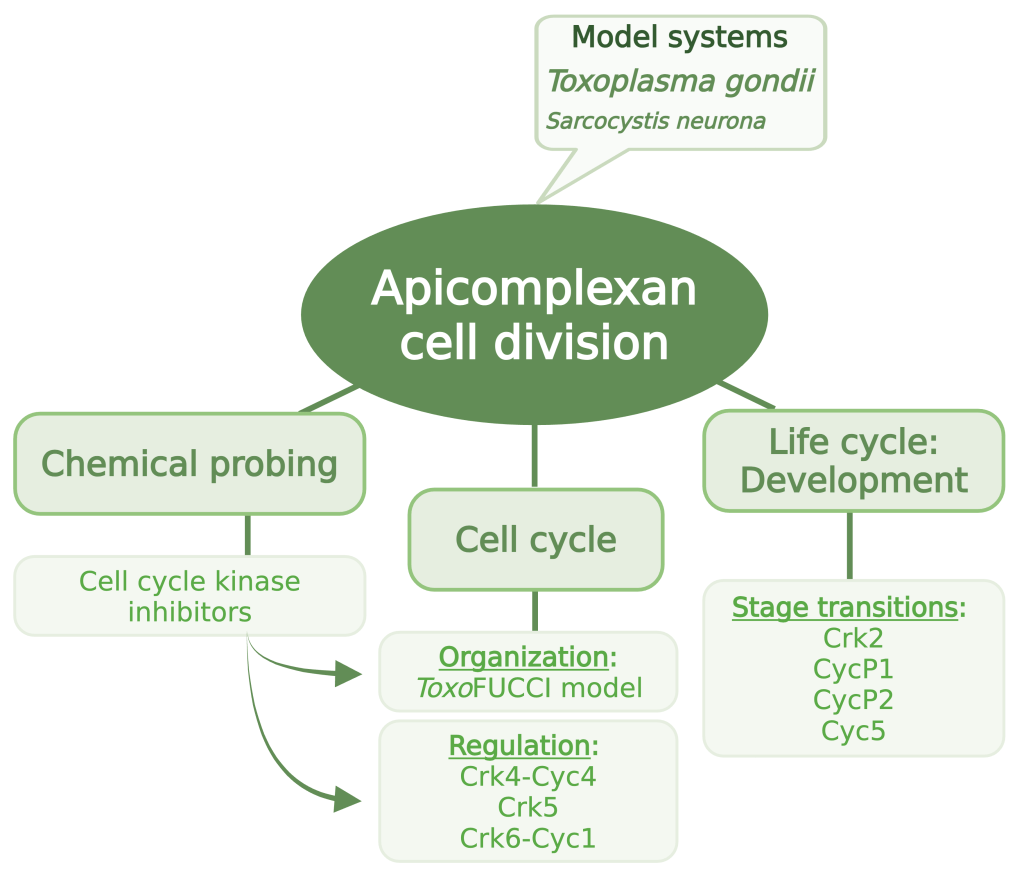
Instead, we detected 7 atypical cyclins (coined P-, H-, L- and Y-type) and 10 novel Cdk-related kinases (Crks) with unknown functions in the T. gondii genome. Gathering comprehensive experimental evidence, we demonstrated that unlike the canonical cell cycle described in yeast and mammalian cells, apicomplexan division requires activity of multiple essential Crks [2]. Using a tet-OFF conditional knockdown in tachyzoites, we showed that the unusual TgCrk2-TgPHO80 complex is required for G1 progression. We also determined that two unexpectedly dynamic TgCrks control mitotic events: nuclear TgCrk6 controls spindle biology, and cytoplasmic TgCrk4 governs centrosome biogenesis in mitosis. On the contrary, a few recognizable T. gondii cyclins are static factors that pair up with non-dynamic TgCrks. These studies provide the first map for the T. gondii tachyzoite division cycle that includes two unique points of regulation in addition to the three canonical points.
Our focus
 The Suvorova Lab